ASTRONOMY Updated Feb. 20, 2020 5:33 PM
One of the biggest and brightest stars in the night sky has left astronomers puzzled after it has faded dramatically over the last year. Some have speculated that this is a sign of an impending supernova explosion, but new observations are pointing toward two new theories.
Betelgeuse is a red supergiant star located around 700 light years away from Earth that can be found glowing orange in the well-known constellation of Orion. It is so massive that if it were placed in the center of our solar system, its surface would extend all the way to Jupiter.
Over the past several months, Betelgeuse has dimmed significantly causing a bit of a stir in the astronomical community. Stargazers stepping outside to look for Betelgeuse will find a star that is just 36% as bright as it was just a year ago, according to the European Southern Observatory (ESO).

Betelgeuse glowing orange (in upper left of the photo above) in the Orion constellation.
The sudden plummet in brightness has caused some to speculate if this is a signal that Betelgeuse will explode in a cataclysmic event known as a supernova. These are some of the largest explosions in the known universe and mark the end of the life of a massive star.
“Betelgeuse will eventually explode as a supernova blasting its store of heavy elements out into our galaxy,” NASA reported.
“This explosion might happen tonight ... or within the few hundred thousand years,” NASA added. It is hard to predict with precision when exactly a star like Betelgeuse will explode.
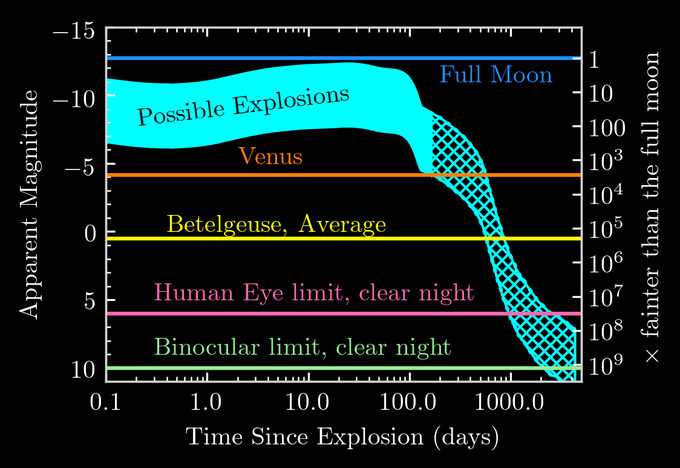
If Betelgeuse does explode, it would be a spectacle that would not soon be forgotten. It is estimated that the supernova would be nearly as bright as a full moon and would easily be visible in the sky in the middle of the day for weeks.
Although 700 light years may sound close on a cosmic scale, the massive star is far away enough from Earth that when it does explode, it would not cause any harm to life on our planet, according to EarthSky.
How bright will #Betelgeuse be when it blows up? Moon-ish brighness for 3+ months, seen during the daytime for about a year, brighter than the star now for ~2 years, naked eye visible for ~3 years. Credit: @UCSBPhysics grad students Jared Goldberg and Evan Bauer using MESA. 1/

426 people are talking about this
While death by supernova is certainly a possibility for the short-term fate of Betelgeuse, it seems unlikely. “Like all red supergiants, Betelgeuse will one day go supernova, but astronomers don’t think this is happening now,” the ESO said.
A team of scientists led by Miguel Montargès, an astronomer at KU Leuven in Belgium, has been observing Betelgeuse since December using the Very Large Telescope in Cerro Paranal, Chile, one of the few facilities on Earth capable of taking detailed images of the surface of Betelgeuse.
Through these detailed observations, they have formulated two new possibilities to describe Betelgeuse’s dimming: Either a large cloud of dust was ejected toward the Earth, obscuring our view of the star; or there is a large area of cooling on the star’s surface due to ‘exceptional stellar activity.’

This comparison image shows the star Betelgeuse before and after its unprecedented dimming. The observations, taken with the SPHERE instrument on ESO’s Very Large Telescope in January and December 2019, show how much the star has faded and how its apparent shape has changed. (ESO)
“Betelgeuse's irregular surface is made up of giant convective cells that move, shrink and swell. The star also pulsates, like a beating heart, periodically changing in brightness. These convection and pulsation changes in Betelgeuse are referred to as stellar activity," the ESO explained.
“Of course, our knowledge of red supergiants remains incomplete, and this is still a work in progress, so a surprise can still happen,” Montargès added.
Is this change in brightness normal for a star?
Like a snowflake, every star in the universe is unique, but they can be broken up into several categories based on their characteristics.
By definition, Betelgeuse is classified as a semiregular variable star, meaning that its brightness will naturally fluctuate up and down. However, its recent activity has been unprecedented in modern history.

This artist’s impression shows the supergiant star Betelgeuse as it was revealed thanks to state-of-the-art techniques on ESO’s Very Large Telescope. Click here for a larger version of the image. (ESO/L. Calçada)
According to data collected by the American Association of Variable Star Observers (AAVSO), Betelgeuse’s brightness has dropped to its lowest levels in over a century.
The brightness of stars (and other objects such as Jupiter or the moon) are measured on a scale known as the apparent magnitude. The brighter the star, the lower the number.
On average, Betelgeuse ranks around 10th on the list of brightest stars in the sky with a magnitude averaging around 0.5, according to the University of Wisconsin-Madison’s Department of Astronomy. But the recent observations show Betelgeuse closer to a magnitude 1.5, meaning that it doesn’t even make the top-20 list of brightest stars in the night sky.
“The light variations of Betelgeuse are not completely understood,” the AAVSO said on its website.
RELATED:
Despite the fainter appearance, Betelgeuse is an easy star to find in the night sky for stargazers of all ages, even for those in light-polluted cities.
It is the orange star glowing in Orion, a well-known constellation that appears high in the southern sky after nightfall. It remains visible most of the night, weather permitting, before setting in the west around 4 a.m. local time.
Keep checking back on AccuWeather.com and stay tuned to the AccuWeather Network on DirecTV, Frontier and Verizon Fios.


No comments:
Post a Comment