Thursday, September 28, 2023

What To Expect From Hurricane Season In October, November

 Chris Dolce

Published: September 26, 2023


O​ctober marks the start of the final leg of Atlantic hurricane season, and although activity begins to slowly wind down, recent years have shown us impactful hurricanes can still strike the U.S.

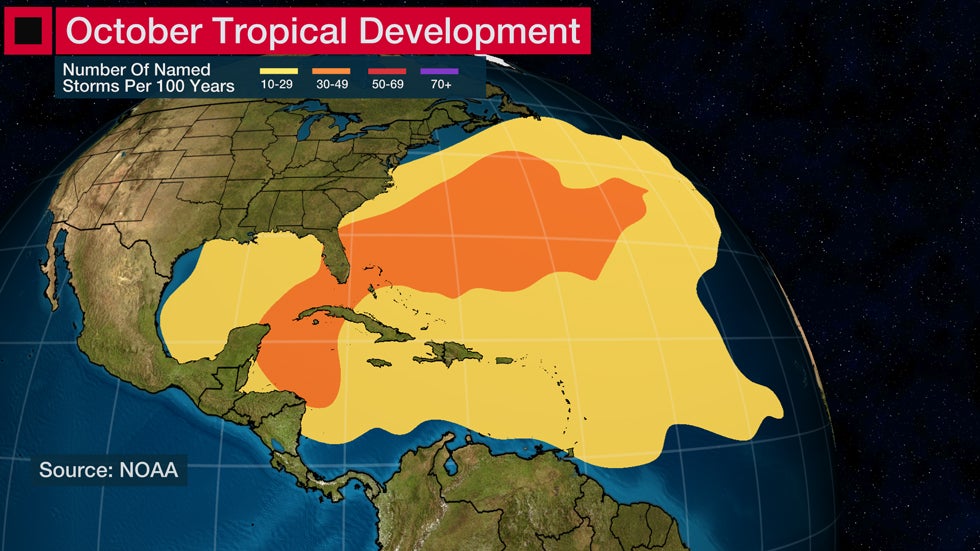
The breeding ground for storms begins to contract late in the season: In October, the most favored area for tropical storms and hurricanes to form shifts westward toward the western Caribbean Sea, eastern Gulf of Mexico and far western Atlantic Ocean. That's because the "Cape Verde" portion of the hurricane season, featuring the development of African easterly waves in the eastern Atlantic Ocean, fades.

Hurricane season usually quiets down even more as we head into November, especially for the U.S.
Article image

Hurricane formations become fewer through the end of the season: The Atlantic has had 233 hurricanes form in October since 1851, according to NOAA. That works out to an average of a little more than one hurricane forming during the month each year.

The most hurricanes to form in October was five in 2010, although 2020 came close with four.

N​ovember's number of Atlantic hurricanes drops off sharply, with just 56 total in 171 years of record keeping.

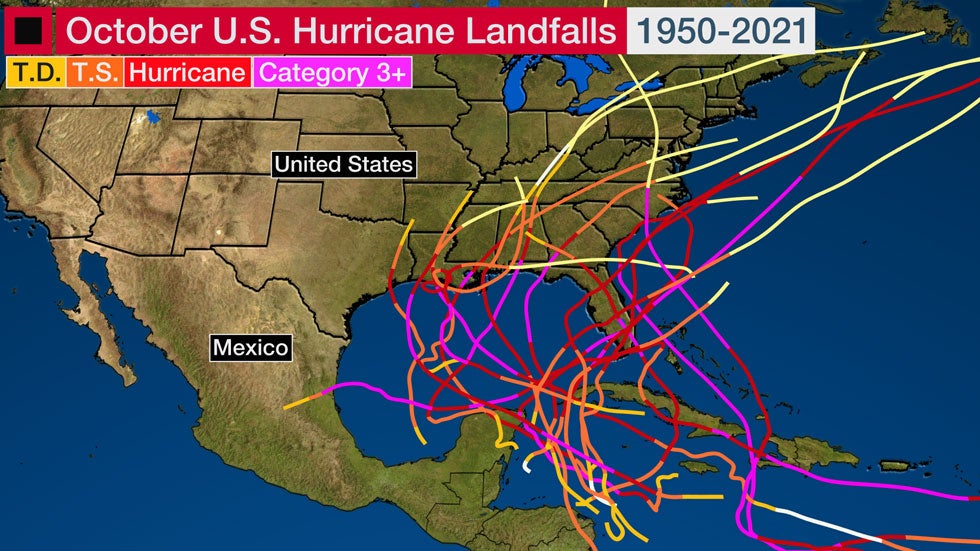
1​9 hurricanes have made a U.S. landfall in October since 1950: A majority of those landfalls occurred from Louisiana eastward to Florida and the Southeast coast. Florida has the most landfalls in the month with 10 since 1950, followed by Louisiana with six.

It becomes more difficult for hurricanes to make landfall farther north in October as the upper-level wind pattern changes and the jet stream slides farther south. Superstorm Sandy hit the Northeast in late-October 2012, but it was no longer classified as a hurricane when it pushed ashore along the New Jersey coast.

N​ovember U.S. hurricane landfalls are extremely rare, with just four ever documented.
Article image

R​ecent years have shown the impacts hurricanes can still bring to the U.S. late in the season: Since 2016, Hurricanes Matthew, Nate, Michael, Delta, Zeta and Nicole have all made a U.S. landfall in October or November.

Michael had the most devastating impacts of those recent hurricanes because it was an extremely rare Category 5 U.S. landfall in the Florida Panhandle on Oct. 10, 2018.

Last year, Hurricane Nicole made landfall in Florida on Nov. 10. It was the first U.S. hurricane landfall in November since Kate struck the Panhandle in 1985.

Article imageInfrared satellite loop of Category 5 Hurricane Michael making landfall near Mexico Beach, Florida, on October 10, 2018.

Chris Dolce has been a senior meteorologist with weather.com for over 10 years after beginning his career with The Weather Channel in the early 2000s.

The Weather Company’s primary journalistic mission is to report on breaking weather news, the environment and the importance of science to our lives. This story does not necessarily represent the position of our parent company, IBM.
The Weather Company’s primary journalistic mission is to report on breaking weather news, the environment and the importance of science to our lives. This story does not necessarily represent the position of our parent company, IBM.
Tropical Storm Ophelia Spread Flooding, Gusty Winds Up The East Coast (RECAP)

 Jonathan Belles and Jon Erdman

Published: September 24, 2023


Tropical Storm Ophelia spread heavy rain, storm surge flooding, strong wind gusts and high surf along the Eastern Seaboard.

O​phelia became the 16th storm of the 2023 Atlantic hurricane season early on September 23. Ophelia developed from an area of energy and spin in the mid-levels of the atmosphere that began over the Deep South and swung southeastward across Florida and into the western Atlantic.

T​he system developed strong winds and increasing surf while sitting over the warm Gulf Stream current on Sept. 21, and attained winds of 40+ mph by late evening. It took on subtropical, then tropical characteristics as it neared the North Carolina coast.

O​phelia may have been a hurricane for a very short time either late on Sept. 22 or early on Sept. 23. Surface winds measured by the Hurricane Hunters temporarily briefly fluttered around 75 mph and an eye feature was briefly seen on radar and satellite data.

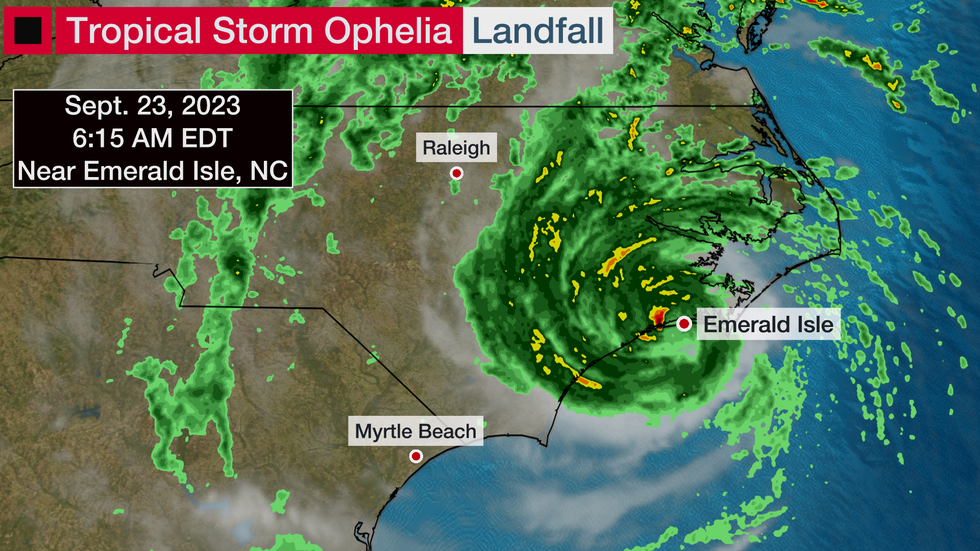
T​he storm made landfall at about 6:15 a.m. EDT on Sept. 23 near Emerald Isle, North Carolina. At landfall, Ophelia had maximum sustained winds of 70 mph, just shy of hurricane strength.

Article image

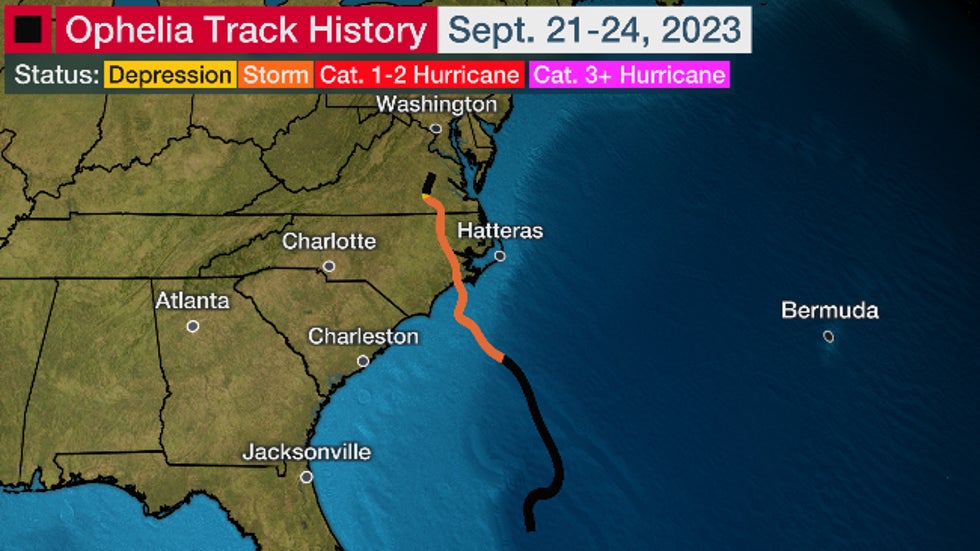
Following landfall, O​phelia quickly weakened as it moved through eastern North Carolina and eastern Virginia on September 23. Ophelia lost tropical characteristics late in the evening near Richmond, Virginia.

Article imageThe black segments of the track above correspond to when this was either "Potential Tropical Cyclone Sixteen" (south of the N.C. coast) or a "post-tropical cyclone" over Virginia.

I​mpacts

S​torm Surge

Storm surge battered eastern North Carolina from late on Sept. 22 through Sept. 23.

Several feet of storm surge washed over the Outer Banks of North Carolina and into much of eastern North Carolina, including New Bern. Four feet of inundation was reported on Sept. 23 along the Neuse River near Janeiro.

Docks and homes ended up in the water on the Pamlico River, in the town of Belhaven.

A storm surge of over 3.5 feet was recorded at a station at Sewell's Point, Virginia, early on Sept 23. A storm surge of 2-4 feet was common from northeastern North Carolina into the lower Chesapeake Bay.

U​p to 2 feet of coastal flooding reached into the Upper Chesapeake Bay, including Annapolis and the inner harbor of Baltimore. About 2.5 feet of flooding pushed up the lower Potomac River into Alexandria, Virginia.

A​bout 2 to 2.5 feet of inundation from flooding was also observed along the coast of Delaware and southern New Jersey at high tide.

S​ignificant beach erosion, with water around some homes, was reported in Bowers Beach, Delaware. Numerous roads were closed due to flooding in Atlantic City, New Jersey.

R​ainfall

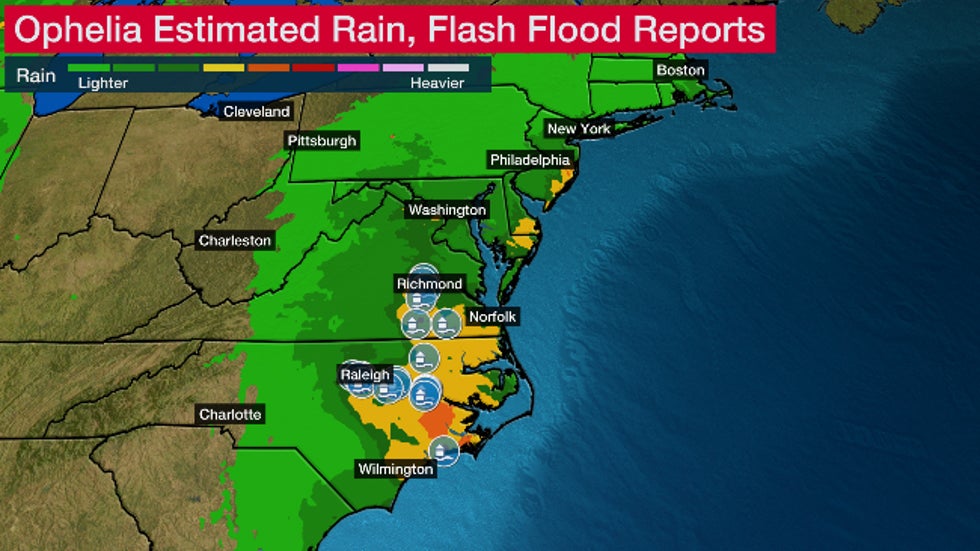
In North Carolina, an estimated 8 to 10 inches of rain fell across Greenville and Pitt Counties, which pushed the Green Mill Run, a creek in Greenville, to its highest level in four years, according to the National Weather Service. Flooding closed numerous roads and required water rescues in the city of Greenville, including areas near East Carolina University.

Article image

F​lash flooding also was reported at two intersections in Richmond, Virginia.

H​ere are some other notable rainfall totals by state:

-​ 8.82 inches in Jacksonville, North Carolina

-​ 5.63 inches in Hartfield, Virginia

-​ 5.23 inches near Toms River, New Jersey

-​ 3.98 inches near Huntingtown, Maryland

-​ 3.80 inches near Millsboro, Delaware

-​ 3.58 inches near Myrtle Beach, South Carolina

-​ 2.78 inches near Carlisle, Pennsylvania

W​inds

A buoy about 30 miles offshore of Wrightsville Beach, North Carolina, reported a wind gust of 83 mph.

S​trong winds tore parts of a roof off of a condo building near Ocean City, Maryland.

S​cattered trees and power lines were downed, some on homes and vehicles, from North Carolina to Maryland. Tens of thousands were without power from Ophelia.

G​usty conditions and increased surf reached as far north as New Jersey and Long Island. In Delaware, wind gusts were occasionally over 30 mph as bands of rain moved through. In New Jersey, waves are occasionally topped the seawall in Wildwood.

H​ere are some of the peak rain and wind gusts by state:

-​ 72 mph: Cape Lookout, North Carolina

-​ 64 mph: Lewes, Delaware

-​ 63 mph: Chesapeake Light Tower in Virginia

-​ 62 mph: North Beach Haven, New Jersey

-​ 56 mph: Cape St. Claire, Maryland

-​ 44 mph: Myrtle Beach, South Carolina

The Weather Company’s primary journalistic mission is to report on breaking weather news, the environment and the importance of science to our lives. This story does not necessarily represent the position of our parent company, IBM.

The Weather Company’s primary journalistic mission is to report on breaking weather news, the environment and the importance of science to our lives. This story does not necessarily represent the position of our parent company, IBM.

NASA's Bennu Asteroid Sample Lands

 Jan Wesner Childs

Published: September 24, 2023


A​ piece of an asteroid collected in space by NASA careened down to Earth in a protective capsule and landed in the Utah desert Sunday.

Crews were set to pick it up and whisk it away to a nearby clean room. Upon inspecting the sample return capsule and surrounding landing zone, NASA officials confirmed the capsule was safe and unbreached.

U​nlike when humans return to Earth from space, there was no weather call. But the landing team monitored winds and other conditions throughout the morning.

W​hat is the NASA asteroid mission all about?

-A NASA spacecraft called OSIRIS-REx launched on an Atlas V rocket from Cape Canaveral, Florida, on Sept. 8, 2016. “It spent about two years traveling to the asteroid Bennu, an additional two years studying the asteroid, surveying its surface to try to figure out the best site to collect the sample from. It collected that sample in October of 2020," NASA scientist Giada Arney told weather.com in an interview Friday.

-OSIRIS-REx is the first U.S. mission to collect a sample from an asteroid.

-The material collected from Bennu is expected to provide a window into the formation of the sun and planets 4.5 billion years ago. “We like to think about these asteroids as pristine time capsules that record the very early formation of our solar system," Arney said.

-​The sample will be taken to NASA's Johnson Space Center in Houston. "About 25% of the sample will be sent to science teams around the world," Arney said. "But about 75% of it will remain in storage for future generations of scientists who might be asking questions that we can't even think of today."

The role of weather in Sunday's landing:

-​Bennu's mini fridge-size deployed a parachute to slow its descent before it hit Earth. That made winds a potential concern.

-​Planners also had to take rain into consideration. If the ground were to get too wet from late-summer monsoons, the landing zone could have turned into a mess of sloppy mud that would make recovery of the capsule more difficult. The landing narrator mentioned there was some mud present, which made for a softer landing.

-​Weather balloons flew up to about 60,000 feet in the days before the landing to capture data including temperature, humidity and wind. Those measurements were to help narrow down a more specific landing spot on the vast Utah Test and Training Range.

W​eather.com senior meteorologist Jonathan Erdman said Friday:

-Fortunately, the weather looks great for the landing in the desert of western Utah.

-Showers and thunderstorms earlier this week will be gone by this weekend as high pressure builds in.

-We expect south to southeast winds around 10 mph on Sunday, probably not strong enough to pose any major problems for the parachute landing.

M​ORE ON WEATHER.COM

-​How Queen's Brian May Helped NASA Map An Asteroid

-​Harvard Professor Skips Retirement For Chance To Help Save The Planet

-Photo Captures Boy's Joy Of Seeing Starship Launch

Weather.com reporter Jan Childs covers breaking news and features related to weather, space, climate change, the environment and everything in between.

The Weather Company’s primary journalistic mission is to report on breaking weather news, the environment and the importance of science to our lives. This story does not necessarily represent the position of our parent company, IBM.

The Weather Company’s primary journalistic mission is to report on breaking weather news, the environment and the importance of science to our lives. This story does not necessarily represent the position of our parent company, IBM.

Tuesday, September 26, 2023

Coastal Flood Advisory Source: U.S. National Weather Service START 7:00 PM Tuesday, September 26 END 12:00 AM Wednesday, September 27

 ...COASTAL FLOOD STATEMENT REMAINS IN EFFECT UNTIL 11 AM EDT THIS MORNING... ...COASTAL FLOOD ADVISORY REMAINS IN EFFECT FROM 7 PM THIS EVENING TO MIDNIGHT EDT TONIGHT...

  * WHAT...For the Coastal Flood Statement, up to a half foot of inundation above ground level expected in vulnerable areas near the waterfront and shoreline. For the Coastal Flood Advisory, up to one and a half feet of inundation above ground level expected in vulnerable areas near the waterfront and shoreline. * WHERE...In Connecticut, Southern Fairfield County. In New York, Southern Westchester County. * WHEN...For the Coastal Flood Statement, from 7 AM EDT early this morning until 11 AM EDT late this morning. For the Coastal Flood Advisory, from 7 PM this evening to midnight EDT tonight. * IMPACTS...Localized minor coastal flooding is expected with the high tide this morning. Minor flooding is expected in the most vulnerable locations near the waterfront and shoreline this evening in low lying, vulnerable areas. Some roads and low lying property including parking lots, parks, lawns and homes/businesses with basements near the waterfront will experience shallow flooding. PRECAUTIONARY/PREPAREDNESS ACTIONS... If travel is required, allow extra time as some roads may be closed. Do not drive around barricades or through water of unknown depth. Take the necessary actions to protect flood-prone property.

Asteroid named for Egyptian god of chaos and darkness set for spacecraft flyby

 After delivering an asteroid sample to Earth Sunday, the newly expanded OSIRIS-APEX mission is heading to Apophis. The asteroid will come within 20,000 miles of Earth in 2029.

Editor's note: Sign up for CNN’s Wonder Theory science newsletter. Explore the universe with news on fascinating discoveries, scientific advancements and more.

(CNN) — After successfully delivering NASA’s first asteroid sample collected in space, the OSIRIS-REx mission, now renamed OSIRIS-APEX, is embarking on a new journey — this time to study an asteroid that will closely approach Earth in just a few years.

Apophis, a space rock roughly 1,200 feet (366 meters) across, will come within 20,000 miles (32,187 kilometers) of Earth in about 5 ½ years, which is closer than satellites that orbit our planet and 10 times nearer than the moon. The asteroid was named for the Egyptian god of chaos and darkness and is believed to be shaped like a peanut.

One hour after Apophis makes its close approach to Earth on April 13, 2029, OSIRIS-APEX — which is short for Origins, Spectral Interpretation, Resource Identification and Security-APophis Explorer — will use Earth’s gravity to enter an orbit around the asteroid and closely study it for 18 months.

An artist's rendering shows OSIRIS-APEX kicking up dust so it can study Apophis. University of Arizona


It’s an extensive new chapter for a spacecraft that has already been on quite the journey. As OSIRIS-REx, it spent seven years on a round trip to the near-Earth asteroid Bennu, which included time spent surveying, touching down on and collecting a sample from the space rock.

Now, the sample is at its new home in NASA’s Johnson Space Center in Houston, where an analysis of the rocks and soil collected from the near-Earth asteroid Bennu could reveal insights into the origin of our solar system and the composition of asteroids that could collide with Earth in the future.

The spacecraft won’t be able to collect a sample from Apophis, because the sample collection head was included in the capsule with the Bennu sample delivered to Earth. But OSIRIS-APEX will use its gas thrusters in an attempt to kick up dust and small rocks both on and below Apophis’ surface to study them about 15 months after orbiting the asteroid.

What Apophis could reveal

Apophis is of interest because it’s an S-type, or stony, asteroid, in contrast to Bennu, which is a C-type, or carbonaceous, asteroid.

C-type asteroids are made of clay and silicate rocks, while S-types are comprised of silicate materials and nickel-iron.

The spacecraft’s ability to closely orbit the asteroid can reveal the surface strength of stony asteroids and how much weathering the asteroid endures in the space environment.

But planning to defend Earth is another key motivation for the extended mission. Stony asteroids are part of the most common class of potentially hazardous asteroids that pose a threat to our planet. Understanding their composition and other details that can only be obtained from a close orbit could help agencies such as NASA and its partners determine how best to deflect such asteroids if they are predicted to be on a collision course with Earth.

“Apophis is one of the most infamous asteroids,” said Dani DellaGiustina, principal investigator of OSIRIS-APEX. “When it was first discovered in 2004, there was concern that it would impact the Earth in 2029 during its close approach. That risk was dismissed after subsequent observations, but it will be the closest an asteroid of this size has gotten in the 50 or so years asteroids have been closely tracked, or for the next 100 years of asteroids we have discovered so far.

An illustration depicts OSIRIS-APEX's anticipated close flyby of Apophis in 2029. Heather Roper/University of Arizona

“It gets within one-tenth the distance between the Earth and moon during the 2029 encounter,” added DellaGiustina, an assistant professor of planetary sciences at the University of Arizona. “People in Europe and Africa will be able to see it with the naked eye, that’s how close it will get. We were stoked to find out the mission was extended.”

Observations of Apophis’ orbit around the sun in 2021 ruled out the risk of the space rock impacting Earth in 2068, according to NASA’s Center for Near-Earth Object Studies.

The center maintains a risk list, tracking asteroids with orbits that bring them close to Earth — close enough to cause concern over a potential impact. Scientists at the center use radar and telescopes to study near-Earth objects and understand the dangers they may pose to the planet.

Keeping an eye on Apophis during and after its close approach to Earth will enable scientists to see whether there are any shifts in its orbit that could affect the likelihood of it hitting Earth in the future, as well as any changes in the asteroid’s surface or rotation rate.

DellaGiustina has a long history with the spacecraft and also currently works as the deputy principal investigator for the analysis of the Bennu sample. As a freshman at the University of Arizona in 2004, she took an asteroids seminar taught by Dante Lauretta, regents professor of planetary sciences and principal investigator of the OSIRIS-REx mission.

“(DellaGiustina) led a student experiment design for a discovery version of what we called Osiris back then,” Lauretta recalled. “Now, she takes the spacecraft on to the next adventure.”

More Space News:

The-CNN-Wire™ & © 2023 Cable News Network, Inc., a Warner Bros. Discovery Company. All rights reserved.

41-year-old woman found dead after Florida alligator is spotted with a body in its mouth

 “I could tell there was a body in his mouth, so I started recording,” one witness said.

An alligator floats in a pond during the second round of the Honda Classic golf tournament, Friday, Feb. 24, 2023, in Palm Beach Gardens, Fla. (AP Photo/Lynne Sladky)

(CNN) — Florida authorities have identified the woman found dead after an alligator was seen with a body in its mouth.

Authorities responded to a call in Largo, in the Tampa Bay area, about a gator in the water about 1:50 p.m. on Friday.

The Pinellas County Sheriff’s Office on Saturday identified the victim as Sabrina Peckham, 41.

A witness, JaMarcus Bullard, told CNN affiliate Spectrum News 13 that he earlier saw an alligator with a body in its mouth.

“I could tell there was a body in his mouth, so I started recording,” Bullard said.

Officials humanely killed the 13-foot, 8.5-inch male, according to the sheriff’s office and Florida Wildlife Conservation Commission.

Alligators have been spotted in the area before, but resident Jennifer Dean told Spectrum News 13 that she had never seen one this large.

“A lot of my neighbors were out here and they’re the ones that told me about the gator,” Dean said. “While we were standing here we heard a shot. I assume they killed the gator.”

More to read:

The-CNN-Wire™ & © 2023 Cable News Network, Inc., a Warner Bros. Discovery Company. All rights reserved.

Man missing at sea for nearly 2 weeks found alive in life raft off Washington coast

  One of two men missing at sea for nearly two weeks was found alive on Thursday by a Canadian fishing boat in a life raft in Canadian water...