By Adriana Navarro, AccuWeather staff writer
& Chaffin Mitchell, AccuWeather staff writer
Updated Apr. 30, 2020 6:41 PM
Cuckoo, Cuculus canorus, single bird on post, Midlands, April 2011.
Paging Bette Midler. She might be able to fly higher than an eagle, but can she fly faster than a cuckoo?
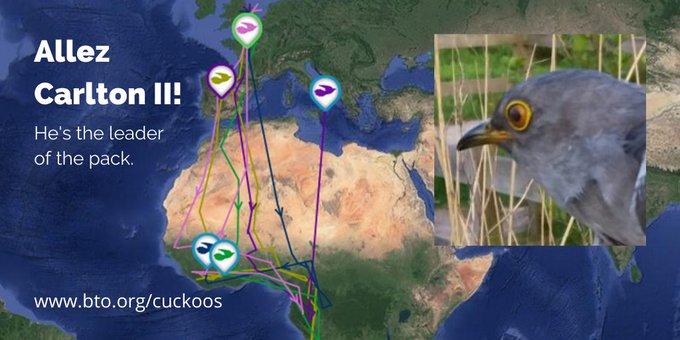
A bird making his annual migration from central Africa to the United Kingdom completed the trip faster than has ever been done before, landing his name in the record books -- and it appears some strong winds may have aided the unprecedented flight.
Carlton II, a cuckoo from Suffolk, England, started his journey in the west African country of Gabon, and then made his way to the Ivory Coast. From there, he soared over the Sahara Desert to England, traveling 4,677 miles in just seven days, despite a multitude of possible weather setbacks. A flight covering this distance usually takes a cuckoo two or three weeks to complete,
The Evening Standard reported.
"It’s a journey so full of hazards -- including high winds, ferocious hailstorms and thunderstorms, and lengthy sea crossings -- that it’s always a relief when they get back, no matter how fast or slow," Chris Hewson, lead scientist on The British Trust for Ornithology's cuckoo-tagging project,
told The Daily Mail.
The
British Trust for Ornithology (BTO) tracked Carlton II throughout his journey along with a handful of other birds. Movement from Carlton II was first noted on Feb. 21, and he completed his sky-bound odyssey five weeks later on April 25. All told, the trip was about 10,377 miles long. The BTO said Carlton II completed the trip faster than any of its other tagged birds ever have.
It was the seven-day stretch from the Ivory Coast to France that impressed ornithologists as Carlton II, they said, rode a strong and persistent southerly wind toward Europe.
“As for the weather, there would have been at least a weak to moderate tailwind from the south part of the way,” AccuWeather
Senior Meteorologist Jim Andrews said.
On April 15, the satellite tracking Carlton II marked the bird at the Ivory Coast. The following day, he was nearly across the Sahara flying northward. By April 18, the satellite showed Carlton to be in northern France, and then he crossed the English Channel by April 21.
The weather at the time appears to have been favorable for the avian speedster.
“There was a slow-moving storm near the Iberian Peninsula while there was a strong high over the central Mediterranean as the bird was crossing the western Mediterranean, which generated strong and persistent southerly winds over the area,” AccuWeather Senior Meteorologist Jason Nicholls, who leads international weather forecasting, said of the conditions Carlton II encountered.
The fast-track voyage is reminiscent of
British Airways Flight 11, which broke a new speed record as it was aided by wind from Storm Ciara on its flight from JFK to Heathrow earlier this year. The flight reached its destination in 4 hours and 56 minutes -- a trip that has an average flight time of 6 hours and 13 minutes,
according to Flightradar24.
Carlton II had been tagged with a satellite tag in May 2018 by BTO, so scientists can track his migration pattern. He is one of a handful of birds that the group closely monitors.
Since having his tag fitted two years ago, The Daily Mail reports,
Carlton II has flown more than 22,000 miles on his migration between his two homes.
The BTO uses tracking technology to find out why the population is decreasing since
half of the Cuckoos in the United Kingdom have disappeared over the last 20 years.
Scientists have linked the different routes taken by cuckoos to the decline and some of the adverse conditions, including habitat loss and drought, that they face while on migration,
according to The Guardian, but it looks as though Carlton II has mastered the route.
A #fire broke out late Friday near a mountain in #Goseong,#GangwonProvince of #SouthKorea,forcing hundreds of people to evacuate and local authorities to call for help from nearby cities. No casualty had been reported as of 10:20 p.m.