Sunday, April 5, 2020

South Dakota River Has Been in Flood Stage for a Full Year


Jonathan Belles and Chris Dolce
Published: April 2, 2020


Flooding continues on a river in South Dakota a year after it was first triggered by heavy rain and snowmelt from a Plains bomb cyclone last March.
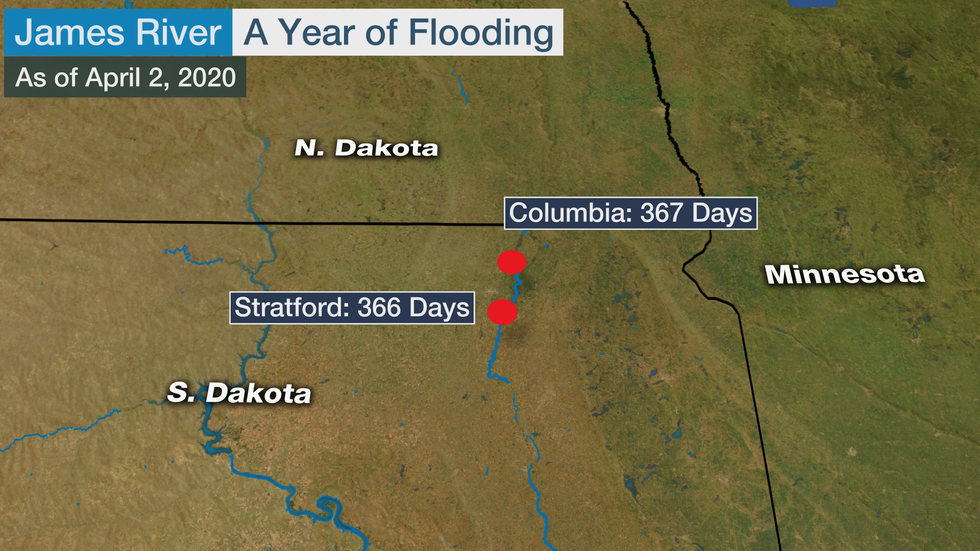
The two river gauges on the James River that have been in flood for more than 365 days. Red dots show where moderate flooding is ongoing.
Two river gauges on the James River in eastern South Dakota have been above flood stage for 365 or more days. Columbia leads the way with 366 days above flood stage, or since April 2 of last year, which was weeks after the bomb cyclone brought disastrous flooding to parts of the Plains.
The James River flows into the Missouri River at the border between Nebraska and South Dakota. From there, its waters head into the Mississippi River and eventually the Gulf of Mexico.
Most of the current flooding on the James River is confined to low-lying and/or rural and agricultural areas, but the flooding could worsen in the spring.
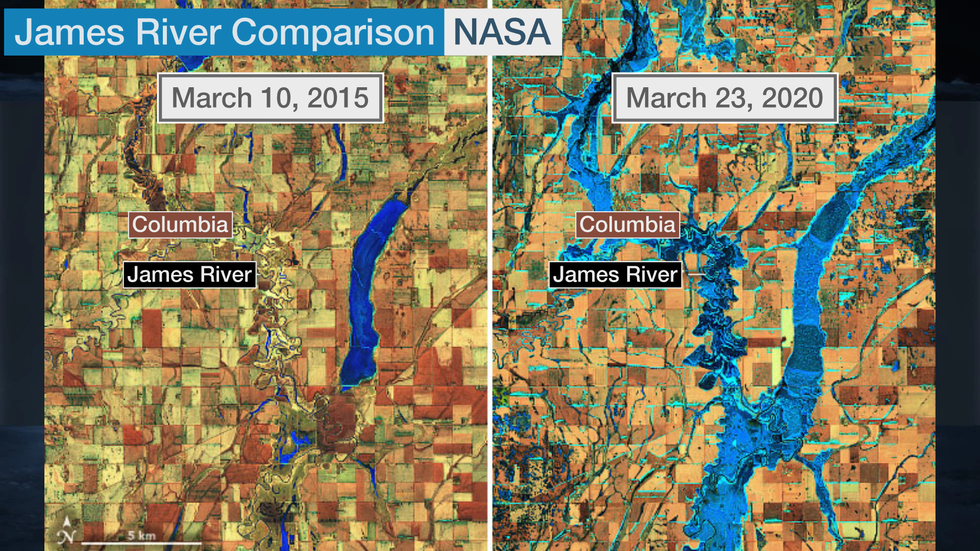
Landsat 8 caught the extent of the flooding in late March, showing the river in blue, compared to a more normal James River in 2015.
"The river levels never fell in the winter because the ground was fully saturated when it froze last fall," Amy Parkin, a meteorologist at the National Weather Service office in Aberdeen, South Dakota, told NASA.
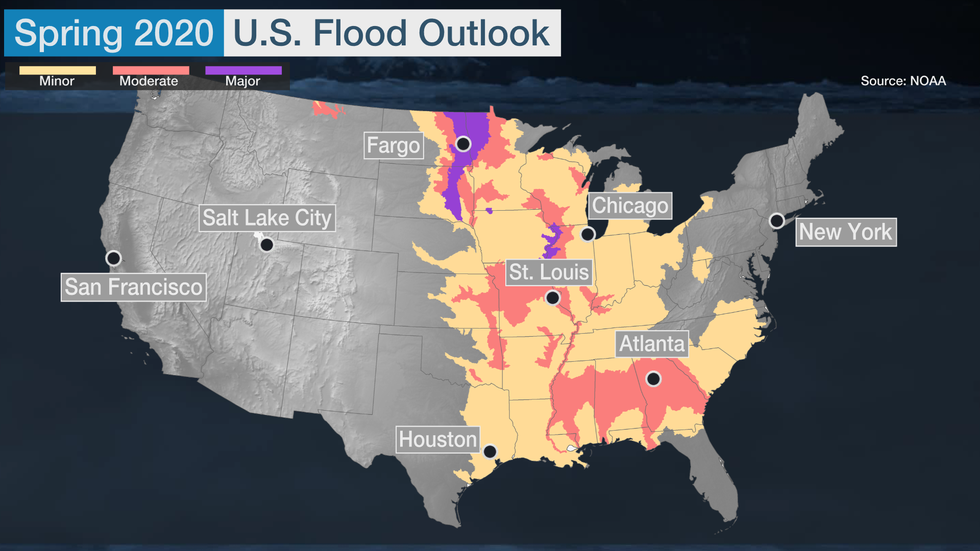
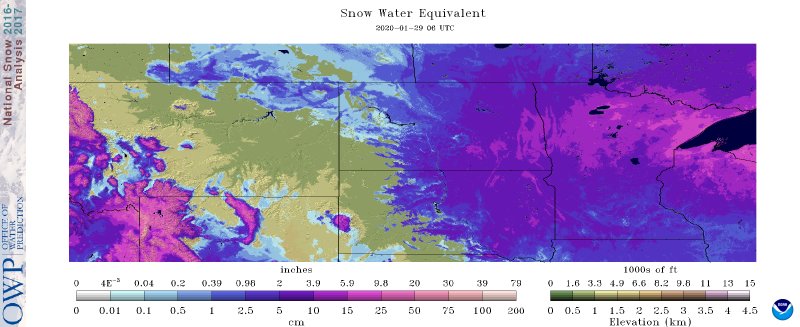
There is a 50% or higher chance of major flooding on the James River at some point in the spring, according to a long-term flood risk outlook from NOAA shown below. One factor in that forecast is the significant snowpack across the river's drainage basin.
Spring snowmelt is already increasing water levels on the James River and more snow is falling, as of April 2.
Rain and melting snowpack is how this long-duration flooding began last March and will assuredly rejuvenate flood concerns this spring.
The Dakotas had the wettest year on record in 2019, which bled into a warmer-than-average and wetter-than-average winter for South Dakota.
The Weather Company’s primary journalistic mission is to report on breaking weather news, the environment and the importance of science to our lives. This story does not necessarily represent the position of our parent company, IBM.

2020 Atlantic Hurricane Season Expected to Be More Active Than Normal, Colorado State University Outlook Says


Jonathan Belles and Brian Donegan
Published: April 2, 2020


The 2020 Atlantic hurricane season is predicted to be more active than usual, according to an outlook released Thursday by the Colorado State University Tropical Meteorology Project.
The group led by Dr. Phil Klotzbach calls for 16 named storms, eight hurricanes and four major hurricanes. A major hurricane is one that is Category 3 or higher (115-plus-mph winds) on the Saffir-Simpson Hurricane Wind Scale.
This forecast is above the 30-year average (1981 to 2010) of 12 named storms, six hurricanes and three major hurricanes.
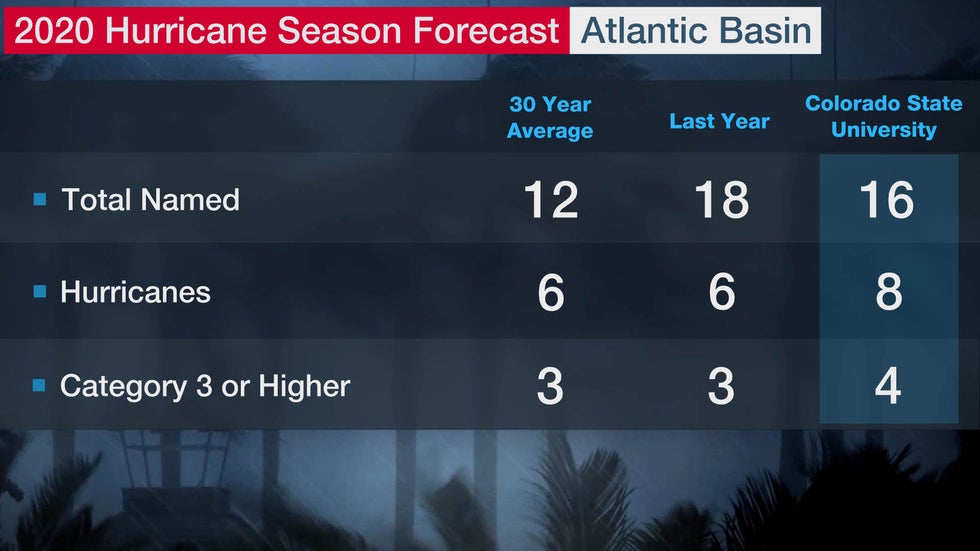
Numbers of Atlantic Basin named storms (those that attain at least tropical or subtropical storm strength), hurricanes and hurricanes of Category 3 or higher intensity forecast by Colorado State University compared to the 30-year average (1981 to 2010) and totals from the 2019 season.
"We anticipate that the 2020 Atlantic Basin hurricane season will have above-normal activity," Klotzbach said.
Though the official Atlantic hurricane season runs from June through November, storms can occasionally develop outside those months, as was the case in the previous three seasons with May 2019's Subtropical Storm Andrea, May 2018's Tropical Storm Alberto and April 2017's Tropical Storm Arlene.
The CSU outlook is based on more than 30 years of statistical factors combined with data from seasons exhibiting similar features of sea-level pressure and sea-surface temperatures in the Atlantic and Eastern Pacific oceans.
Here are some questions and answers about what this outlook means.

What Does This Mean for the United States?

There is no strong correlation between the number of storms or hurricanes and U.S. landfalls in any given season. One or more of the 16 named storms predicted to develop this season could hit the U.S. or none at all. But Klotzbach noted this year could be quite busy for the United States.
"We anticipate an above-average probability for major hurricanes making landfall along the continental United States coastline and in the Caribbean," Klotzbach said. "As is the case with all hurricane seasons, coastal residents are reminded that it only takes one hurricane making landfall to make it an active season for them. They should prepare the same for every season, regardless of how much activity is predicted."
A couple of examples of why you need to be prepared each year occurred in 1992 and 1983.
The 1992 season produced only six named storms and one subtropical storm. However, one of those named storms was Hurricane Andrew, which devastated South Florida as a Category 5 hurricane.
In 1983, there were only four named storms, but one of them was Alicia. The Category 3 hurricane hit the Houston-Galveston area and caused almost as many direct fatalities there as Andrew did in South Florida.
In contrast, the 2010 Atlantic season was quite active, with 19 named storms and 12 hurricanes. Despite the high number of storms that year, not a single hurricane and only one tropical storm made landfall in the United States.
In other words, a season can deliver many storms but have little impact, or deliver few storms and have one or more hitting the U.S. coast with major impact.
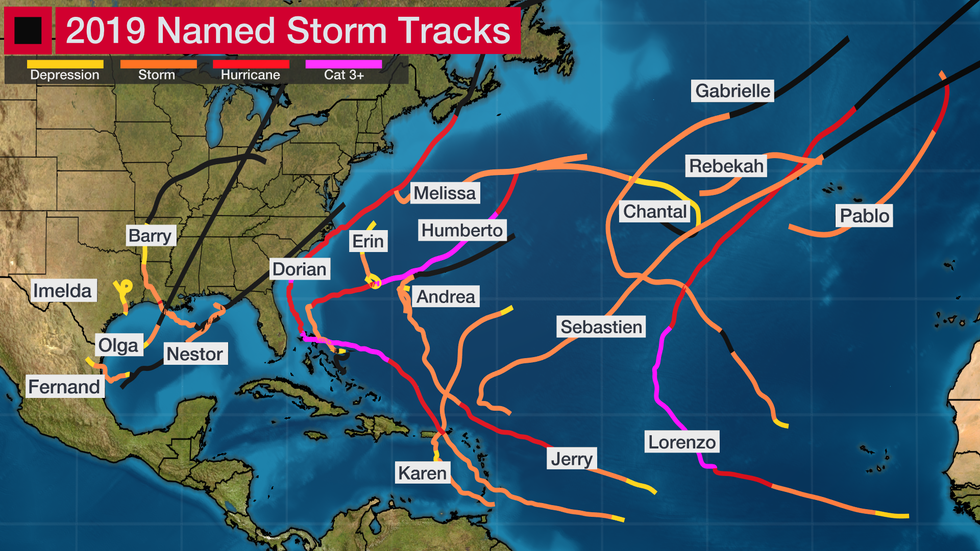
Named storm tracks in the 2019 Atlantic hurricane season. The colors correspond to intensities of each named storm during that section of the track, except for the black sections, which correspond to either a remnant or the time during which a system was a tropical wave before forming into a depression or storm.
The U.S. averages one to two hurricane landfalls each season, according to NOAA's Hurricane Research Division statistics.
In 2019, there were two U.S. hurricane landfalls – Barry in Louisiana and Dorian in North Carolina.
In 2018, four named storms impacted the U.S. coast, most notably hurricanes Florence and Michael within a month of each other.
In 2017, seven named storms impacted the U.S. coast, including Puerto Rico, most notably hurricanes Harvey, Irma and Maria, which battered Texas, Florida and Puerto Rico, respectively.
Before that, the U.S. was on a bit of a lucky streak.
The 10-year running total of U.S. hurricane landfalls from 2006 through 2015 was seven, according to Alex Lamers, a meteorologist at the National Weather Service. This was a record low for any 10-year period dating to 1850, and considerably lower than the average of 17 per 10-year period dating to 1850.
None of the U.S. landfalls from 2006 through 2015 were from major hurricanes.
The bottom line is it's impossible to know for certain if a U.S. hurricane strike will occur this season. Keep in mind that even a weak tropical storm hitting the U.S. can cause major impacts, particularly if it moves slowly and triggers flooding rainfall.

How Much of a Role Will El Niño or La Niña Play?

El Niño/La Niña, the periodic warming/cooling of the equatorial eastern and central Pacific Ocean, can shift weather patterns over a period of months. Its status is always one factor that is considered in hurricane season forecasting.
As of early spring, a weak Modoki El Niño was in place, but waters in March slowly cooled. Klotzbach noted that a transition to neutral (neither El Niño nor La Niña) or potentially even weak La Niña conditions is likely by this summer or fall.
Long-range forecasters at both NOAA and The Weather Company, an IBM Business, were generally in agreement with Klotzbach, suggesting that neutral conditions are anticipated through the first half of the hurricane season (June through August, or JJA), with either neutral or La Niña conditions possible in the second half (September through November, or SON).
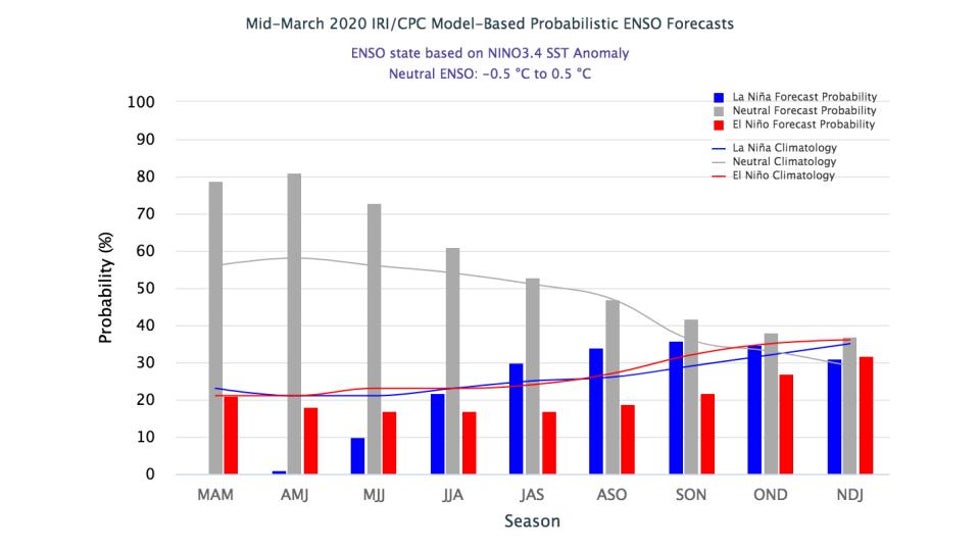
Model-Based El Niño/La Niña Outlook Through the End of the Year
We should note here, before talking about the impacts of a possible La Niña, that the status of the El Niño-Southern Oscillation (ENSO) is notoriously difficult to predict. This is especially true from February to May, when the "spring predictability barrier" is in play, a period when forecast skill is lower than the rest of the year.
La Niña generally acts as a speed boost to the Atlantic hurricane season, but it is just one factor that can lead to an active year. Hurricane seasons can be active even if La Niña is not in play.
La Niña typically corresponds with a more active hurricane season because the cooler waters of the Eastern Pacific Ocean end up causing less wind shear along with weaker low-level winds in the Caribbean Sea. La Niña can also enhance rising motion over the Atlantic Basin, making it easier for storms to develop.
The La Niña years of 2010 and 2011 are among several tied for the third-most-active Atlantic seasons on record (both years had 19 named storms). The next La Niña year, 2016, was also quite active, with 15 named storms that included Category 5 Matthew and three other major hurricanes. La Niña conditions recurred midway through the hyperactive and catastrophic 2017 season that produced Harvey, Irma and Maria.

Other Factors in Play

One of the other ingredients that meteorologists, including Klotzbach and the CSU team, are looking at going into the hurricane season is how warm the Atlantic, Caribbean and Gulf of Mexico are.
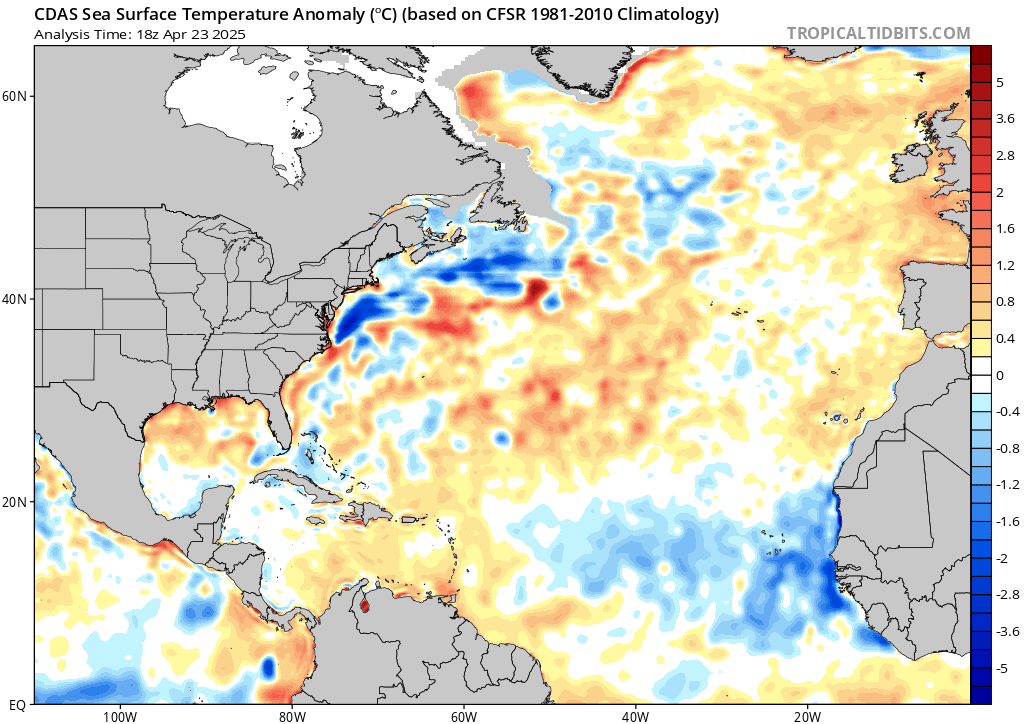
Much of the Atlantic Basin's waters are already above average temperature-wise. The Gulf of Mexico is also several degrees above average, given recent heat and the lack of rain over the Southeast.
But it isn't ocean temperatures in April that will help boost or curtail tropical systems. Rather, it is water temperatures during the hurricane season that will do that.
Climate models suggest that most of, if not the entire, basin will be warmer than average in the peak of the hurricane season.
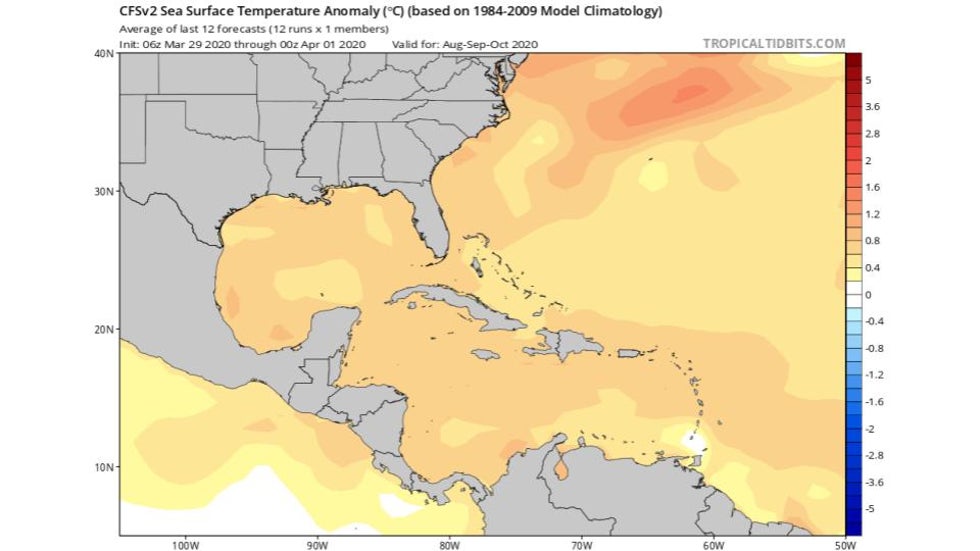
Forecast Water Temperature Anomalies for August through October
An above-average number of tropical storms and hurricanes is more likely if temperatures in the main development region (MDR) between Africa and the Caribbean Sea are warmer than average. Conversely, below-average ocean temperatures can lead to fewer tropical systems than if waters were warmer.
Assuming atmospheric factors are favorable, warmer waters in the MDR allow tropical waves, the formative engines that can eventually become tropical storms, to get closer to the Caribbean and the United States.
The prevalence of wind shear and dry air across the Atlantic will also need to be watched over the next six to eight months.
If La Niña does kick in toward the end of the season, as many forecasters expect, and the atmosphere responds to it, then there could be less wind shear and more favorable conditions for hurricane growth toward the end of the season.
How much dry air rolls off the coast of Africa will also need to be monitored. Even if water temperatures are boiling and there is little wind shear, dry air can still disrupt developing tropical cyclones and even prohibit their birth to begin with.
Hurricanes need a rather precise set of ingredients to come together in order for them to fester, so all of these ingredients will need to be monitored this year.
This was the fourth April outlook issued since the passing of Dr. William Gray, noted hurricane researcher and emeritus professor of atmospheric science at CSU.
Gray, who died in April of 2016, was the creator of the yearly Atlantic hurricane season outlooks, which have been published every year since 1984. He developed the parameters for these outlooks in the late 1960s, which was considered groundbreaking research at that time.
The Weather Company’s primary journalistic mission is to report on breaking weather news, the environment and the importance of science to our lives. This story does not necessarily represent the position of our parent company, IBM.

This Date in Weather History for April 5,2020

Weather History
For Sunday,April 5 (Palm Sunday),2020


1945 - The temperature at Eagles Nest, NM, plunged to 45 degrees below zero to establish an April record for the United States. (Sandra and TI Richard Sanders - 1987)
1955 - The Northern Rockies and the Northern High Plains were in the midst of a four day storm which produced 52 inches of snow at Lead, located in the Black Hills of western South Dakota. (David Ludlum)
1972 - A tornado, 500 yards wide at times, touched down at a marina on the Oregon side of the Columbia River, and then tore through Vancouver WA killing six persons, injuring 300 others, and causing more than five million dollars damage. It was the deadliest tornado of the year, and the worst of record for Washington. (The Weather Channel)
1982 - An unprecedented April blizzard began in the northeastern U.S. One to two feet of snow fell across Massachusetts and Connecticut, and up to 26 inches was reported in Maine. New York City received a foot of snow. Winds reached 70 to 80 mph during the storm, and the storm also produced numerous thunderstorms, which contributed to the heavy snow. (Storm Data)
1987 - A storm produced unprecedented April snows in the central Appalachians. Mount Mitchell NC received 35 inches of snow, and up to 60 inches (six feet) of snow was reported in the mountains along the border of North Carolina and Tennessee. The total of 25 inches at Charleston WV easily surpassed their previous record for the entire month of April of 5.9 inches. The 20.6 inch total at Akron OH established an all-time record for that location. (Storm Data) (The National Weather Summary)
1988 - Thirty-nine cities across the eastern half of the country reported record high temperatures for the date, including Saint Louis MO with a reading of 91 degrees. Laredo TX was the hot spot in the nation with an afternoon high of 100 degrees. (The National Weather Summary)
1989 - Unseasonably hot weather prevailed in the southwestern U.S. Afternoon highs of 100 degrees at Santa Maria CA and 105 degrees in Downtown Los Angeles established records for the month of April. (The National Weather Summary)
1990 - Afternoon and evening thunderstorms developing along a cold front produced severe weather in southern Oklahoma, southern Arkansas, and north central and northeastern Texas. Thunderstorms spawned a dozen tornadoes in Texas, including one at Fort Worth which caused a million dollars damage. There were nearly one hundred reports of large hail and damaging winds. Thunderstorms in Texas produced hail three and a half inches in diameter west of Fort Worth, and produced wind gusts to 80 mph at Cross Plains. (The National Weather Summary) (Storm Data)

This Date in Weather History for April 4,2020

Weather History
For Saturday,April 4,2020


1804 - A large tornado crossed six Georgia counties killing at least eleven persons near Augusta. (David Ludlum)
1933 - Pigeon River Bridge, MN, reported 28 inches of snow, which established the state 24 hour snowfall record. (4th-5th) (The Weather Channel)
1973 - Sandia Crest, NM, reported a snow depth of 95 inches, a record for the state of New Mexico. (The Weather Channel)
1983 - Colorado was in the midst of a three day winter storm. Buckhorn Mountain, located west of Fort Collins, received 64 inches of snow. (Storm Data)
1987 - Rains of five to eight inches drenched eastern New York State, and ten persons were killed in a bridge collapse over Schoharie Creek. (The National Weather Summary) (Storm Data)
1988 - Sunny and warm weather prevailed across the nation. Fort Smith AR reported a record high of 90 degrees. (The National Weather Summary)
1989 - Thunderstorms produced severe weather from the Lower Mississippi Valley to the Southern Appalachians. The thunderstorms spawned seventeen tornadoes, including one which caused two million dollars damage at Baldwin AL. Thunderstorm winds gusted to 90 mph at Bremen GA. (The National Weather Summary) (Storm Data)
1990 - A deep low pressure system in northern New York State brought heavy snow to parts of western and central New York during the day. The snowfall total of 5.8 inches at Buffalo was a record for the date, and 9.5 inches was reported at Rochester. Snowfall totals ranged up to 11 inches at Warsaw. (The National Weather Summary) (Storm Data)

This Date in Weather History for April 3,2020

Weather History
For Friday,April 3,2020


1955 - Record snows fell in north central Wyoming and south central Montana. Billings MT received a storm total of 42.3 inches, and on the 4th reported a record snow depth of 35 inches. Sheridan WY established a 24 hour snowfall record of 26.7 inches. (2nd-4th) (The Weather Channel)
1974 - A "Super-Outbreak" of tornadoes ravaged the Midwest and the eastern U.S. Severe weather erupted early in the afternoon and continued through the next day. Severe thunderstorms spawned 148 tornadoes from Alabama to Michigan, most of which occurred between 1 PM (CST) on the 3rd and 1 AM on the 4th. The tornadoes killed 315 persons, injured 5300 others, and caused 600 million dollars damage. Alabama, Kentucky and Ohio were especially hard hit in the tornado outbreak. One tornado destroyed half of the town of Xenia OH killing 34 persons. Another tornado, near the town of Stamping Ground KY, produced a path of destruction a record five miles in width. A tornado raced through Guin AL at a speed of 75 mph. Two powerful tornadoes roared across northern Alabama during the early evening hours, killing fifty persons and injuring 500 others. Some rescue vehicles responding to the first tornado were
1987 - A storm in the southeastern U.S. produced a trace of snow at Mobile, AL, one inch at Jackson MS, and two inches at Meridian MS, the latest snow of record for those three locations. Birmingham AL received seven inches of snow, and up to nine inches was reported in northeast Alabama. (Sandra and TI Richard Sanders - 1987) (The National Weather Summary)
1988 - A wind gust to 114 mph was clocked at Ann Arbor, MI, during a tornadic thunderstorm. Thunderstorms in Michigan and Indiana spawned five tornadoes that Easter Sunday, and also produced golf ball size hail. (The National Weather Summary) (Storm Data)
1989 - Thunderstorms produced severe weather from the Southern Plains to the southern and central Appalachians. The thunderstorms spawned twenty tornadoes, including one which caused eight million dollars damage at Fort Branch IN. (The National Weather Summary) (Storm Data)
1990 - Rain and snow prevailed in the northeastern U.S., with snow reported in New York State. Boston MA was soaked with 2.91 inches of rain during the day and night, and up to half a foot of snow blanketed the hills of Steuben County NY that Tuesday night. (The National Weather Summary) (Storm Data)
2008 - An EF-1 tornado knocks down numerous tress and powerlines, destroys homes in Leawood and Cammack Village and passes directly over the Little Rock National Weather Service office. Six tornados were confirmed in central Arkansas, but no fatalities were reported.

This Date in Weather History for April 2,2020

Weather History
For Thursday,April 2,2020


1975 - The northeastern U.S. was in the grips of a severe storm which produced hurricane force winds along the coast, and two to three feet of snow in Maine and New Hampshire. Winds atop Mount Washington NH gusted to 140 mph. (David Ludlum)
1975 - The biggest snowstorm of record for so late in the season paralyzed Chicago, IL. Up to 20 inches of snow fell in extreme northeastern Illinois, and 10.9 inches of snow closed Chicago's O'Hare Airport. (The Weather Channel)
1982 - Severe thunderstorms spawned fifty-six tornadoes in the central U.S., including seventeen in the Red iver Region of Texas and Oklahoma. The tornadoes claimed thirty lives, and injured 383 other persons. A violent tornado near Messer OK left only the carpet tack strips on the slab of a house it destroyed, and carried a motel sign thirty miles. (The Weather Channel) (Storm Data)
1987 - Eleven cities in Florida reported record low temperatures for the date, including Tallahassee with a reading of 31 degrees. The low of 48 degrees at Key West smashed their previous record for the date by 13 degrees. (The National Weather Summary)
1988 - Thunderstorms produced up to nine inches of rain around New Orleans LA causing 18 million dollars damage. A tornado caused three million dollars damage at Slidell LA. (Storm Data) (The National Weather Summary)
1989 - Strong and gusty winds prevailed from California to Colorado and Wyoming. Winds gusted to 50 mph at Lancaster CA, and reached 85 mph at Berthoud Pass CO. Snow and high winds created blizzard conditions in the Colorado Rockies. (The National Weather Summary) (Storm Data)
1990 - Thunderstorms produced severe weather in North Carolina and Virginia during the afternoon and evening. Thunderstorms produced golf ball size hail, and spawned a tornado near Chester VA which caused half a million dollars damage. A storm system produced snow and gale force winds across northern Michigan, with 8.3 inches of snow reported at Marquette. Temperatures in the north central U.S. soared from morning lows in the 20s and 30s to afternoon highs in the 60s and 70s. Eight cities reported record highs for the date, including Havre MT with a reading of 77 degrees. (The National Weather Summary) (Storm Data)
2005 - Heavy rainfall in the Northeast produced flooding in parts of New York, New Jersey and Pennsylvania. Severe flooding along the Delaware River forced the evacuation of 6,000 residents in New Jersey and over 5,700 in Pennsylvania during the weekend of the 2nd-3rd. Around 3,200 homes in New Jersey were damaged, while one fatality was reported in New York (Associated Press).
2006 - Tornadoes and hail as big as softballs ripped through eight Midwestern states, killing at least 27 people, injuring scores and destroying hundreds of homes. In Tennessee, tornadoes killed 23 people, including an infant and a family of four. Severe thunderstorms, many producing tornadoes, also struck parts of Iowa, Kentucky, Arkansas, Missouri, Ohio, Illinois and Indiana. Strong wind was blamed or at least three deaths in Missouri. The weather service's Storm Prediction Center in Norman, Okla., said it had preliminary reports of 63 tornadoes. The worst damage occurred throughout the Tennessee Valley.

This Date in Weather History for April 1,2020

Weather History
For Wednesday,April 1,2020


1912 - A tornado with incredible velocity ripped into downtown Houston, TX, breaking the water table and giving the city its first natural waterspout. (The Weather Channel)
1923 - Residents in the eastern U.S. awoke on "April Fool's Day" to bitterly cold temperatures. The mercury plunged to -34 degrees at Bergland MI and to 16 degrees in Georgia. (David Ludlum)
1987 - Forty-five cities across the southeastern U.S. reported record low temperatures for the date. Lows of 37 degrees at Apalachicola FL, 34 degrees at Jacksonville FL, 30 degrees at Macon GA, and 22 degrees at Knoxville TN, were records for April. (The National Weather Summary)
1987 - A tornado touched down briefly during a snow squall on the south shore of White Fish Bay (six miles northwest of Bay Mills WI). A mobile home was unroofed and insulation was sucked from its walls. (The Weather Channel)
1988 - A powerful spring storm produced 34 inches of snow at Rye CO, 22 inches at Timpas OK, 19 inches at Sharon Springs KS, and up to 35 inches in New Mexico. Severe thunderstorms associated with the same storm spawned a tornado which caused 2.5 million dollars damage at East Mountain TX. (The National Weather Summary) (Storm Data)
1989 - Up to six inches of snow blanketed the Adirondacks of eastern New York State and the Saint Lawrence Valley of Vermont. Up to a foot of snow blanketed the Colorado Rockies. (Storm Data) (The National Weather Summary)
1990 - Thunderstorms produced severe weather in Texas, from southern Arkansas and northern Louisiana to southern Georgia, and from northern South Carolina to the Upper Ohio Valley during the day and evening. Thunderstorms spawned a tornado at Evergreen AL, and there were more than eighty reports of large hail and damaging winds. Thunderstorms produced baseball size hail north of Bastrop LA, and produced damaging winds which injured one person west of Meridian MS. (The National Weather Summary) (Storm Data)

Man missing at sea for nearly 2 weeks found alive in life raft off Washington coast

  One of two men missing at sea for nearly two weeks was found alive on Thursday by a Canadian fishing boat in a life raft in Canadian water...